
Our rooms bear the high-sounding name of a Roman deity venerated in ancient Pompeii with the exception of the goddess Isis, goddess of Egyptian origin, of whom a temple was found in the ancient Pompeii, testifying the contact at the time between the two civilizations and the multicultural character of the town of Pompeii open to trade with the East and Greece.

Dionysus is considered in mythology the god of the awakening of nature, of the ecstasy of dance and wine. In his honor, the Dionysian festivals were celebrated every year: once in autumn, when there was the harvest, and once in spring. During the feast, poets narrated the deeds of the God, and singers sung songs in his honor, and obviously a lot of wine was also consumed. Dionysus was depicted in two distinct forms: the oldest represented him in a majestic and grave aspect, with a long beard and long hair, dressed in a tunic, surmounted by a cloak; the second form, on the other hand, represented him at a young age, with almost feminine features and a pensive face, a crown of vine leaves and ivy surrounded his curly hair and with a panther or deer skin on the hips. They were sacred to Dionysus among the vegetables: the vine, the ivy, the oak, among the animals: the bull, the goat, the panther, the tiger and the lynx.

Goddess of love, sexuality, fertility and beauty born from the white foam of the sea considered daughter of the heaven and the sea. Venerated as Mother Goddess of nature, her origin related to the sea made her the goddess protector of sailors. As soon as she rose from the waters, the Hours dressed her and adorned her with roses, myrtle and jewels, placing her on a shell where a sanctuary was promptly built. As the goddess of nature, roses and plants are sacred to her, but also animals, such as the dolphin, quail and hare, sparrows, doves and swans, as well as the ram and the snake. Represented over the centuries by countless artists including Botticelli who immortalized its grace and beauty in the 'Birth of Venus'. Together with the god Eros, Aphrodite arouses the desire to fall in love; the goddess also protects marriage and in fact the virgins vow to her before the wedding.

Jupiter is the god of atmospheric elements and the leader of the Greek gods living on the Olympus (name of the Greek mountain where the deities were believed to live). He was the most powerful god, he administered justice in the Universe and guaranteed order everywhere by ruling with an iron fist. Jupiter represented the force of nature and in him the ancient Greeks saw all the human qualities and defects. The ancients represented it with the classic attributions of lightning and aegis, the shield with which it governed natural elements including atmospheric phenomena, and identified it with the fifth planet of the solar system. Its identification tool is the lightning and its main sacred animal is the eagle, which became one of the most common symbols of the Roman army. The two emblems were often combined to represent the god in the form of an eagle holding lightning in its talons, often seen on Greek and Roman coins. As the god of heaven, he was a divine witness to oaths, the sacred trust upon which justice and good governance depend.
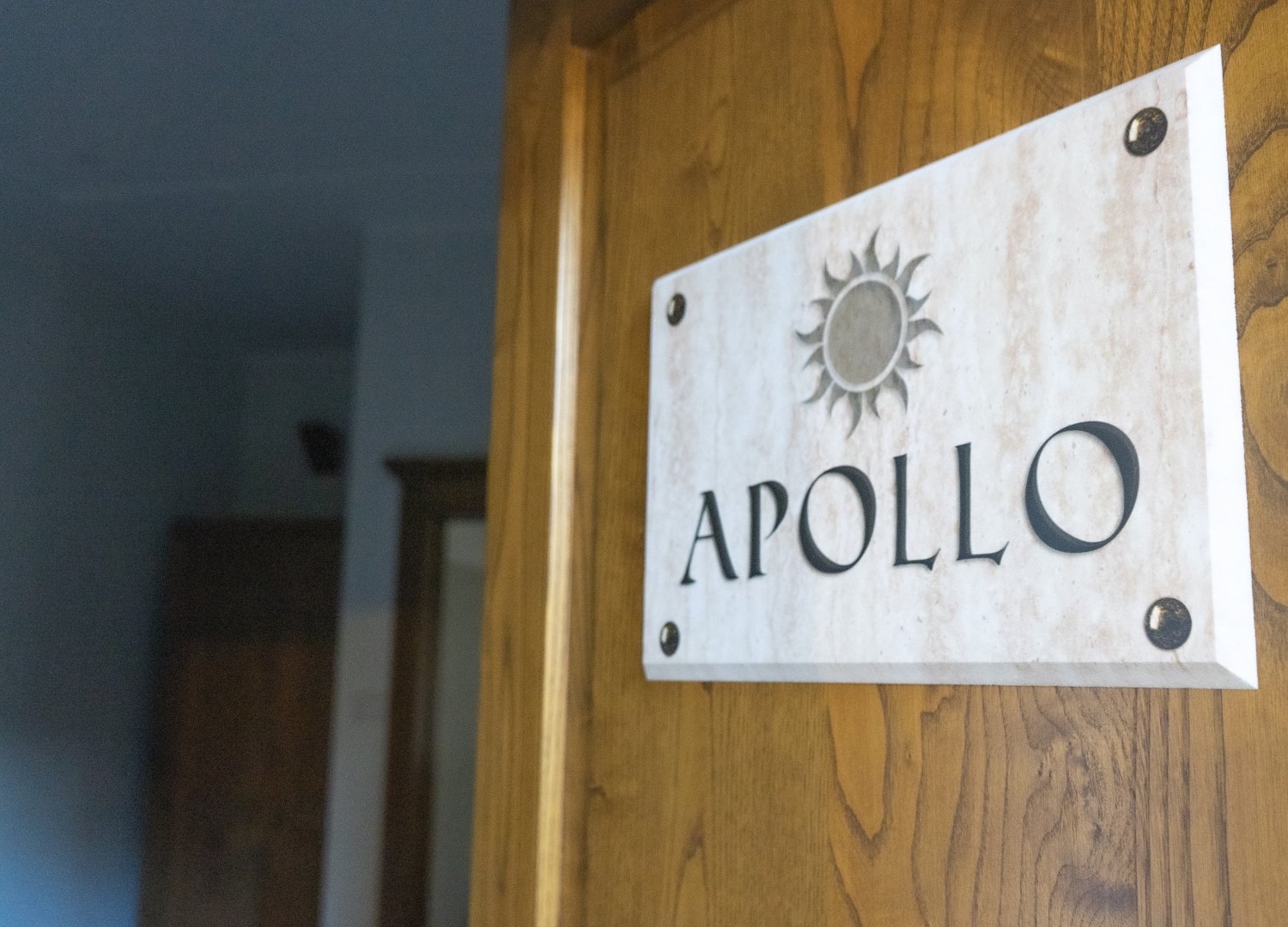
God of the Sun, of music, prophecy, poetry, arts, plagues and science that illuminates the intellect, his main symbol is the Sun or the lyre. As the god of poetry, he is the leader of the Muses. He is also described as a skilled archer capable of inflicting terrible plagues with his weapon on the peoples who opposed him. As protector of the city and the temple of Delphi, Apollo is also revered as an oracular god capable of revealing, through the priestess, called Pythia, the future to human beings. Apollo is usually depicted crowned with laurel, a symbol of victory. Its typical attributes are the bow, with its portentous arrows, and the zither. Another characteristic emblem is the sacrificial tripod, a symbol of his prophetic powers. Animals sacred to the god are swans (symbol of beauty), wolves, cicadas (to symbolize music and song), hawks, crows, dolphins, in which the god often loved to transform himself and snakes, these last with reference to its oracular powers.

Minerva was the Roman goddess of war, wisdom, poetry and medicine as well as protector of artisans. She was considered the virgin deity of warriors, poetry, medicine, wisdom, commerce, arts, as well as the inventor of music. She was usually depicted with the appearance of a young virgin warrior, standing upright wearing the long Greek robe (chiton) and on her chest a chain mail or aegis decorated with the head of Medusa; on her head or in her hand she has a crested helmet and is armed with a round shield and a spear. Its symbols are the owl, its aegis, which has the face of the Medusa, and a shield.

Ancient deity protector of fields and flocks, depicted with pointed ears, horns and goat feet, similar to the god Pan in Greek mythology. He was the god of the countryside, pastures and agriculture. Provocator of visions of dreams and nightmares and revealer of the future through mysterious voices; he was represented with his hips wrapped in a panther or goat skin, a crown of leaves or teeth on his head, a drinking horn in his right hand and a cornucopia or club in his left hand. Among the various names attributed to him there is also "Luperco", defender of the flocks and the inhabitants of the countryside from the assaults of wolves and wolf himself. In honor of the god Faun were celebrated the Lupercalia, purifying feasts that consisted in disperse two groups of priests in the forests, frighteningly made up and dressed with the skins of sacrificed animals. It is also theorized that this rite had also an initiatory function in adulthood and that this holiday is the ancestor of the current Valentine's Day.

Isis, or Isis or Isi, is an Egyptian goddess from the ancient Egypt. Goddess of motherhood, fertility and magic, she is originally from Behbeit el-Hagar, in the Nile Delta. Isis was one of the main goddesses of the ancient Egyptian religion, whose cult spread throughout the Greco-Roman world. Although it was not usual among the ancient Romans to venerate foreign deities, the frequent contacts with ancient Egypt had led to the expansion of the new cult among the Romanesque populations, even reaching the construction of temples on Italic soil such as the famous Temple of Isis found in Pompeii. She was first mentioned during the ancient kingdom, as one of the protagonists of the myth of Osiris, in which she resurrects her husband, the divine king Osiris, after his assassination, and creates and protects her heir Horus. His relationships with humans were based on his actions in the myth. It was believed that she helped the dead to pass into the afterlife as she had helped Osiris. She was considered the divine mother of the pharaoh, who was compared to Horus, and her maternal behavior was invoked in healing spells.

God of wine and harvest, as well as of the pleasure of the senses and fun. His name come from its characteristic of being a very noisy god (in Greek Bacchus means 'clamor'), from which the Italian word baccano derives. He is often depicted as a man with a head surrounded by vine leaves, neither thin nor muscular: usually drunk, he often has a cup of wine or a thyrsus in his hand. His cult (bacchanal) arrived in the peninsula bringing various inconveniences to the community thanks to the lively atmosphere of joy capable of trespassing into wildness characterized by its rites, also called the 'orgies'. The faithful feel possessed by the god and, in a state of exaltation that deprives them of any form of self-control, they indulge in frantic dances and long runs across the mountains. From this religious ceremonies, delirious and unbridled, the dithyramb and dramatic poetry arose. Bacchus had the merit of encouraging the sense of mystery, lyric poetry, nature, eros-pathos and freedom in religion. Often the bacchanal involved several populations of a territory who gathered for several days in a consecrated place where animal sacrifices and sexual practices were practiced for the propitiation of crops, but also for the celebrations of the shepherds who returned from transhumance. Bacchus was accompanied by a joyful and dancing cortege of satyrs, silenes, maenads, thiads and bacchantes, and often with Pan and Priapus, in harmony with his rites of orgiastic intoxication, which he gave to his followers, in the excitement of wine and from the flesh of the victims eaten, even raw, the sensation of incorporating the essence of God and becoming one with him. For the celebrations in his honor, the so-called bacchanals were generally held in secret, initially corresponding to large parties in which considerable political conspiracies were planned. Precisely for this reason, the Roman Senate prohibited the rites of the divinity.